Signs of Turf Drainage Problems in North Las Vegas
North Las Vegas averages 4.18 inches of rain a year, and nearly all of it arrives in hard monsoon bursts that fall faster than the ground can take. A drainage problem here looks like a soft patch that squelches underfoot, water still standing hours after the storm, infill floating over the backing, and a damp smell that survives the next 104.5°F afternoon.
We are a matching service, not an installer: we connect you with vetted local pros across ZIP codes 89030, 89031, 89032, 89081, 89084, 89085 and 89086.
Why Water Stands After a Monsoon Storm
The annual rainfall figure tells you nothing about drainage. What matters is how the rain arrives — short, violent bursts that drop a month of water in an hour. Water that cannot soak in has to go somewhere, and where the base was laid flat, it goes nowhere: it collects between base and backing, the infill floats, the pile mats, and the edges show it first. That water sits warm through July, when the normal daily maximum reaches 104.5°F.
Caliche, Alkaline Hardpan and What Has to Change Under the Base
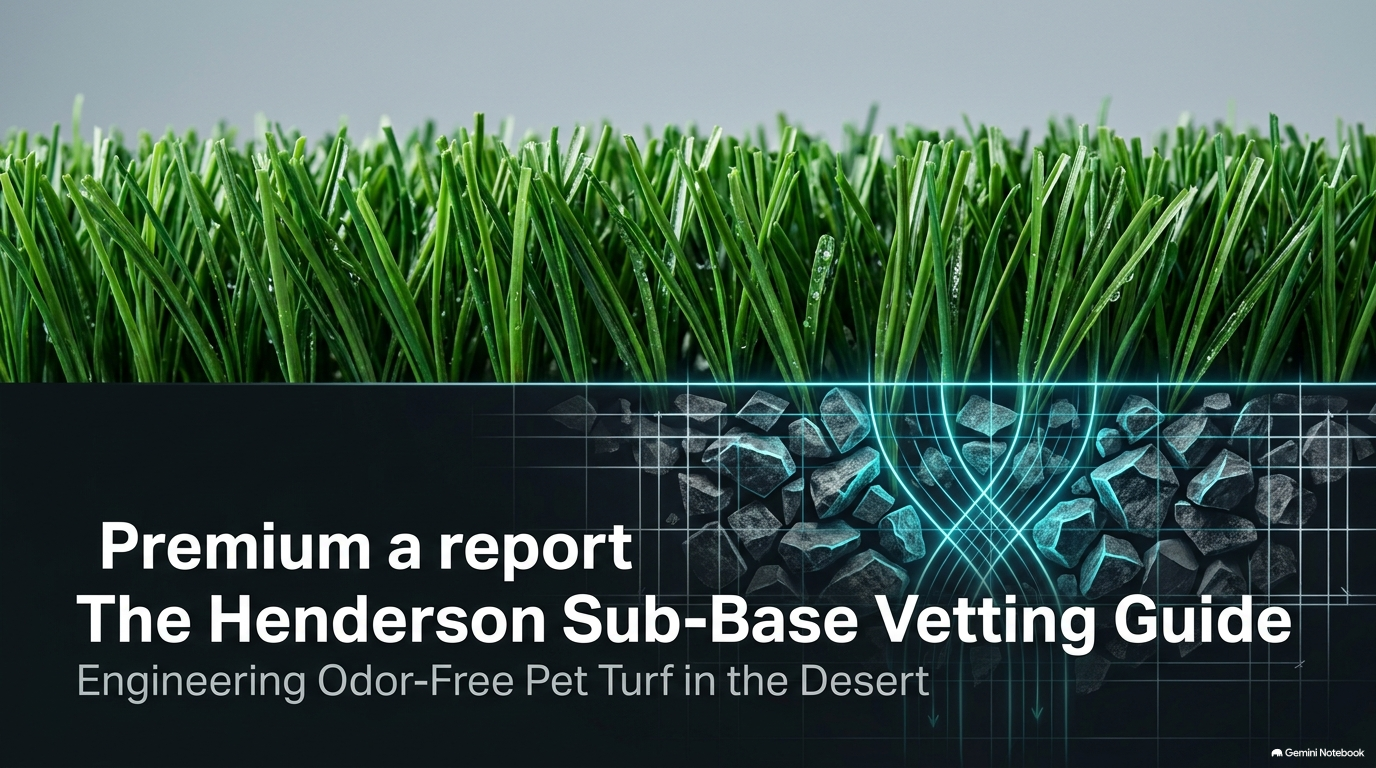
Almost all of this city sits on caliche — cemented calcium carbonate over alkaline desert soil that is close to impermeable once it is compacted. Because the ground beneath will not take water, the base has to move it: break or bridge the caliche, shape the sub-grade so water runs to a low point or out to the street, and build the base up in compacted lifts over a separation layer.
A base that works is graded away from the house, uses enough depth of angular material, is compacted in lifts, carries a geotextile layer, and sits over a permeable backing. Take one out and the rest are undermined.
Watch where water already goes before anyone digs: the ponding spot shows up in a storm, and checking where the roof drains discharge stops the base from carrying the roof too. The turf surface needs no city permit, but grading work, anything inside the right-of-way, and retaining walls over 24 inches each need their own.
Turf Drainage Repair Services in North Las Vegas
The repairs that fix standing water are base work, not surface work. A turf repair specialist can regrade under an existing surface, reset the fall, and re-lay the lifted section; where the surface is coming out anyway, turf installation covers the full build, from breaking caliche to correcting the finished level at the house line.
What Turf Drainage Repair Costs in North Las Vegas
Cost follows the ground, not the turf. Two yards of the same size can price very differently.
What does turf drainage repair cost in North Las Vegas?
There is no flat rate, and a number given before the base is opened is a guess. The price tracks how deep the caliche has to be broken and whether spoil is hauled off, the depth of base material, how the finished level meets the house, street or wall, and how easily equipment reaches the yard. Ask for excavation depth and base build-up as separate line items — that is where two bids usually differ — and compare ranges on our North Las Vegas turf cost page.
How Quickly Standing Water Turns Into a Bigger Repair
A puddle that clears in an hour is a nuisance. Water still there in the morning has reached the backing.
How soon should standing water on artificial turf be dealt with?
Every storm that leaves water trapped under the surface pushes more infill out of place and feeds the weeds that start along a seam, and one wet season left alone usually turns a local repair into a bigger one, because a low spot only gets lower. If water stands for more than a day, have the yard looked at before the next monsoon window. If it drains in a couple of hours, note the spot for your next service visit.
Rebates, HOA Review and City Rules for North Las Vegas Yards
If the repair turns into a replacement, or you take grass out elsewhere in the yard, the SNWA Water Smart Landscapes rebate pays $5.00 per sq ft for the first 10,000 sq ft converted and $2.50 after that. North Las Vegas properties get the base rate — the extra $2 is for Las Vegas Valley Water District customers — and converted ground still needs 50 percent living plant cover, drip irrigation, a 400 sq ft minimum and a mandatory pre-conversion site visit.
Does my HOA have to approve the repair?
Not always, but often. Under NRS 116.330 a Nevada HOA cannot ban artificial turf outright, and that covers turf you are already allowed to keep. It can still require architectural review of anything visible — the usual situation in Aliante or Valley Vista. Re-gluing a seam is normally invisible to anyone else; changing a finished level, a drainage outlet or a perimeter may need a submittal and add time.
Get matched with a local pro. Describe where the water stands and how long it takes to go, and we will connect you with local pros — free, no obligation. The turf problems hub covers everything else that goes wrong, and the free tools measure the area first.